
The era of mega-dams in the Brazilian Amazon appears to be coming to an end, the non-governmental organization International Rivers reported in early January, citing a report in Brazil’s largest newspaper, O Globo, on January 2nd that quoted two high-level government officials.
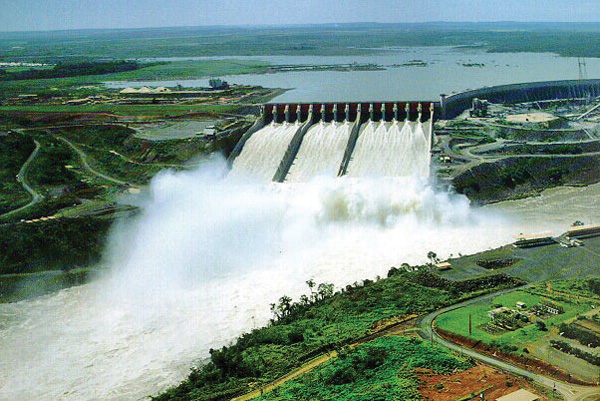 The immense Itaipú power system on the border between Paraguay and Brazil
Luiz Augusto Barroso, the president of the federal energy planning agency, EPE, told O Globo that EPE “decided to take a step back to review the process for planning large hydroelectric dams. There is a paradigm that every hydropower is good and cheap. We are studying to see if all the projects are right. It is not to build any dam under any condition.”
The immense Itaipú power system on the border between Paraguay and Brazil
Luiz Augusto Barroso, the president of the federal energy planning agency, EPE, told O Globo that EPE “decided to take a step back to review the process for planning large hydroelectric dams. There is a paradigm that every hydropower is good and cheap. We are studying to see if all the projects are right. It is not to build any dam under any condition.”
The executive secretary of the Ministry of Mines and Energy, Paulo Pedrosa, told the newspaper, “We have no prejudice against big projects. But they have to respect the social desire to restrict these projects. We are not willing to make moves that mask their costs and their risks.”
These comments mark a striking shift in tone for government agencies that have shown interest in building massive hydropower projects for decades.
The officials’ comments suggest that the government is increasingly aware that social opposition and the falling costs of wind and solar power could cause the Brazilian government to reconsider a number of the country’s remaining mega-dam development proposals. Despite suspending development of the proposed São Luiz de Tapajós Dam last year, planners have not definitively canceled it; they have simply stated that it can’t be finished by 2026 while the environmental and indigenous issues remain unresolved. Meanwhile, the Brazilian government continues to try to develop other projects, like Ribeirão on the Madeira River, on the border with Bolivia.
The economic crisis has limited the funds available for subsidized loans for mega-dams from the state development bank BNDES. However the government may be able to attract Chinese investment, as in the case of the Three Gorges Corporation’s involvement in the São Manoel Dam on the Teles Pires River. Three Gorges has a 33.3% stake in the project.
Brent Millikan, Amazon Program Director at International Rivers, said, “It’s encouraging that Brazilian government officials are beginning to recognize the reality on the ground: that large dams in the Amazon are too expensive, destructive, and corruption-prone to build. But if the government is serious about respecting the rule of law and the wishes of the people, it should cancel all planned dam projects in the Amazon and promote truly sustainable energy alternatives. Until then, we can’t say that the era of large dams in the Amazon has come to an end.”
Christian Poirier of Amazon Watch said, “This policy change reflects not just Brazil’s tough economic realities, but also the growing impact of indigenous peoples, social movements and their allies, who have mobilized in an unprecedented way to protect their rights and their rivers, lives and livelihoods, and will continue to do so as long as threats to their homes and the Amazon remain.”
Source: Internationalrivers.org, with edits by APPrO