Wakefield, Mass.: SGIP, the Smart Grid Interoperability Panel, announced the release December 15 of a white paper to help utilities, regulators, and policymakers advance their understanding of transactive energy (TE), and how it can help integrate distributed energy resources (DER) in smart grids.
 The GridWise Architecture Council’s TE Framework defines TE as “a system of economic and control mechanisms that allows the dynamic balance of supply and demand across the entire electrical infrastructure using value as a key operational parameter.” In other words, a set of built-in incentives and tools at a granular level that would signal the various components of the electric system when to engage, using market rules. The Council was formed by the U.S. Department of Energy to promote and enable interoperability among the many entities that interact with the electric power system. The proposed grid architecture is considered to be important for integrating DER, as well as distribution-level operations, grid efficiency and more.
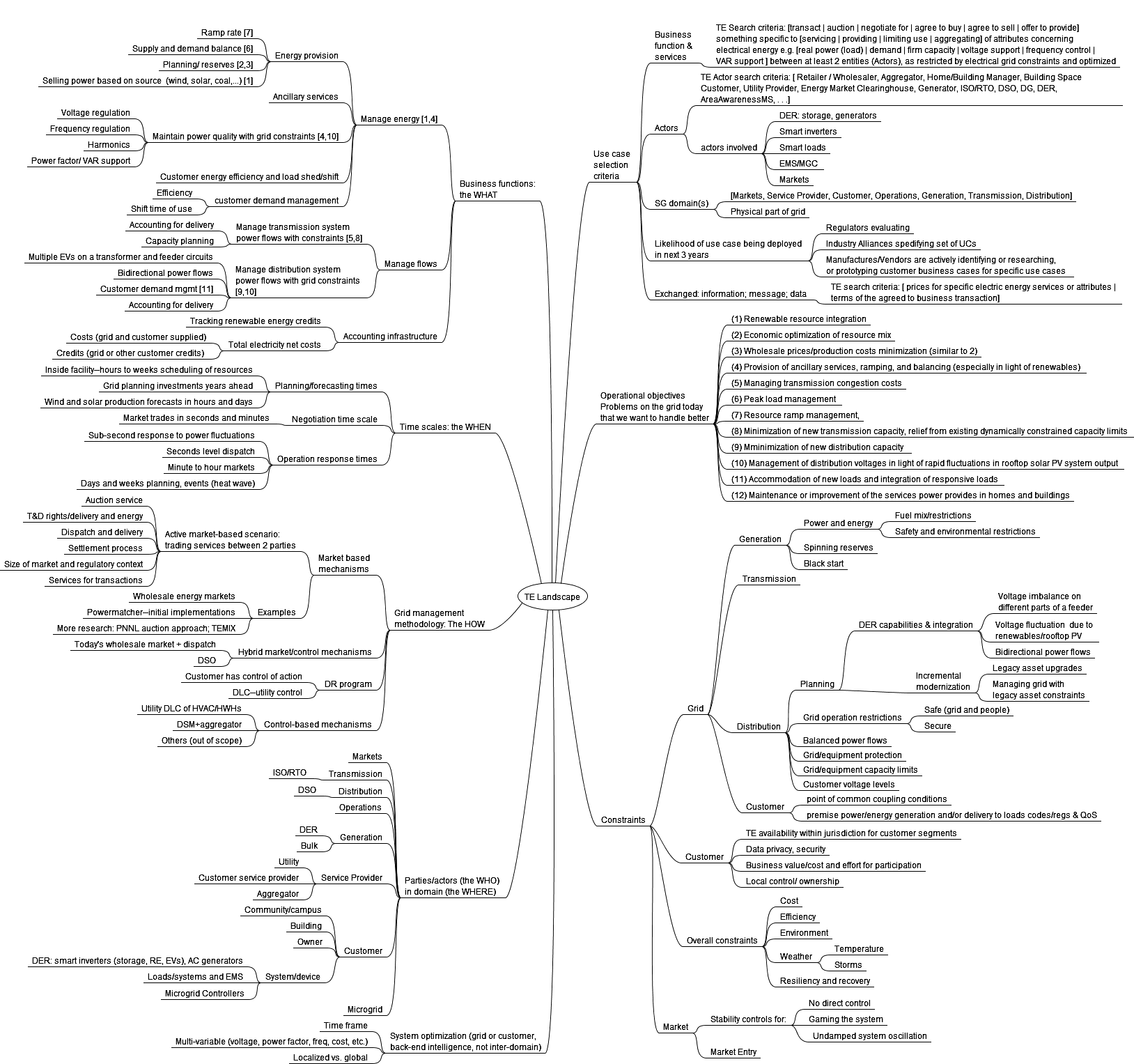
Transactive Energy Application Landscape Scenarios is a free resource from SGIP’s Transactive Energy Coordination Group. It examines the application of transactive techniques to different grid operational scenarios, which include business functions, actors in different smart grid application domains and more.
The white paper provides six high-level, operational scenarios that together outline an electric grid landscape in which a TE system operates:
• A condition of heavy demand, straining grid capacity and requiring additional load shedding/shifting or storage resources. The function would involve engaging any and all customer DER resources in the minutes to hours range to reduce demand levels and increase supply.
• A regional, bulk-power system operator having to balance wind resources with power ratings making up 40 percent of the bulk resource in the region. Balancing is needed for both wind ramps and for fast regulation of wind variability. The objective is to match wind variability closely enough that base load generation can provide fine levels of balancing through automatic generator controls.
• High penetration of rooftop solar PV causing swings in voltage on a distribution grid. The focus here is distribution grid regulation, voltage fluctuations and reverse power flows (and other ancillary services). Time scales: seconds to minutes for negotiation as well as response
• Management of potential overloading at a specific transformer serving several homes each of which has fast-charging electric vehicles. Other customer loads and DER may be incentivized to decrease load or supply power to reduce localized overloading.
• Islanded microgrid energy balancing. TE designs are used to balance the interests of various microgrid participants (e.g., buildings with different owners, homes, commercial and industrial facilities) and other DER.
• A sudden transmission system constraint resulting in emergency load reductions, such as a distribution system network operator who receives most of its power from the bulk power system and is notified by the system reliability coordinator, with 15 minutes notice, that it must curtail 40 MW of load for two hours due to unplanned maintenance of the transmission system. TE would engage any load, generator, or storage resource available on distribution grid.
“With this new white paper, smart grid stakeholders can better see some of the possibilities that come with TE,” said Aaron Smallwood, Vice President, Technology at SGIP. “As DER penetration continues to be a major driving force for interoperability, TE concepts can provide reliability and efficiency to advancing grids.”
”This work represents a distillation of a large variety of use cases into a small set of scenarios that can be used to explore TE designs and key interfaces for standardization,” said Ron Melton, Chair of the Transactive Energy Coordination Group at SGIP. The group’s Secretary, David Holmberg, added, “Interoperable TE systems depend on common understanding and collaborative efforts enabled by this work. This will lead to more effective TE technologies available sooner to meet emerging critical grid needs.”
For further information, please see: www.sgip.org